The study tools
Everything below is on the drive and works without an internet connection.
Original languages and definitions
The King James Version was translated from Hebrew and Greek into the English of 1611. The LivingWordApp lets you look through both layers.
Interlinear: Hebrew and Greek
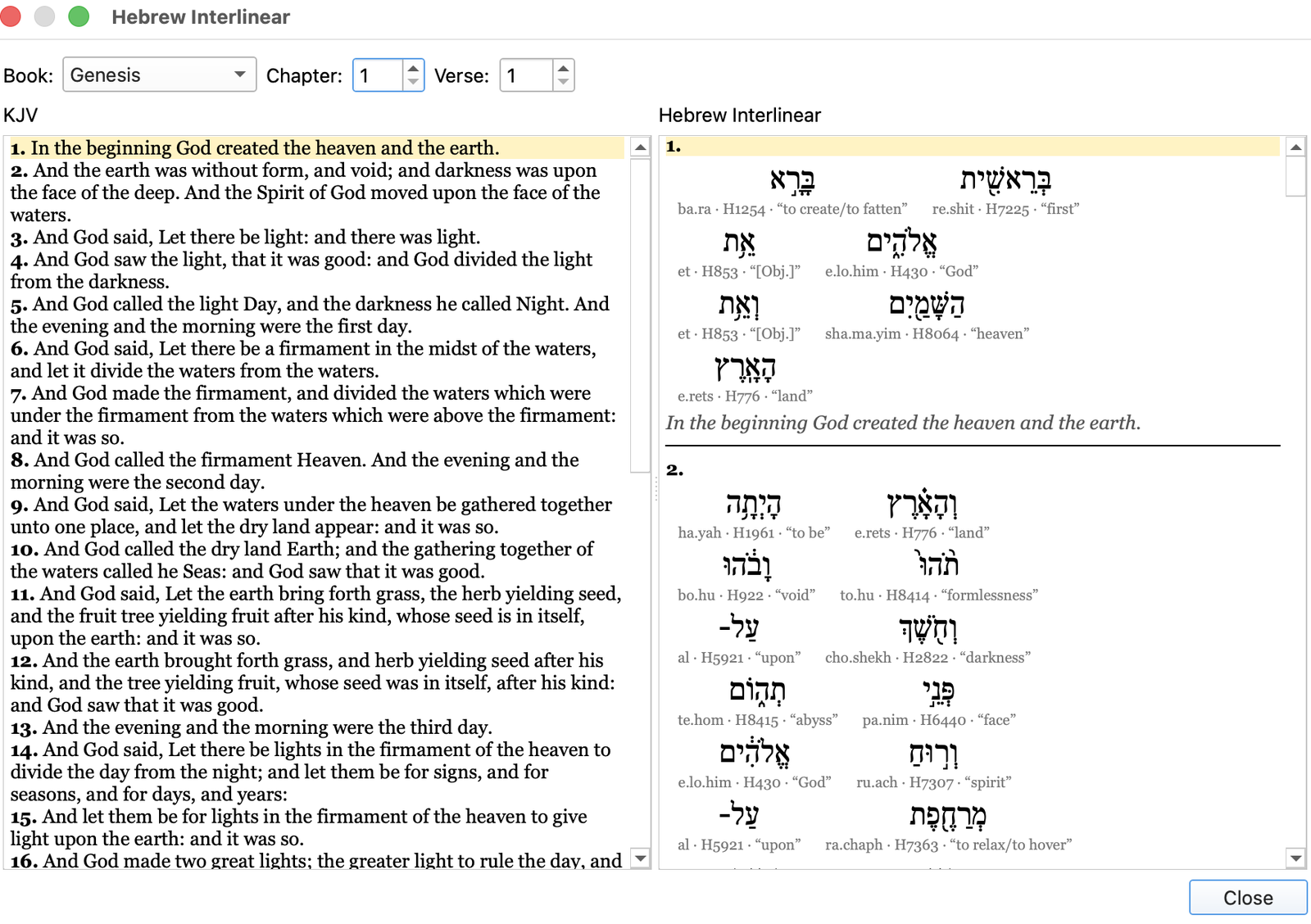
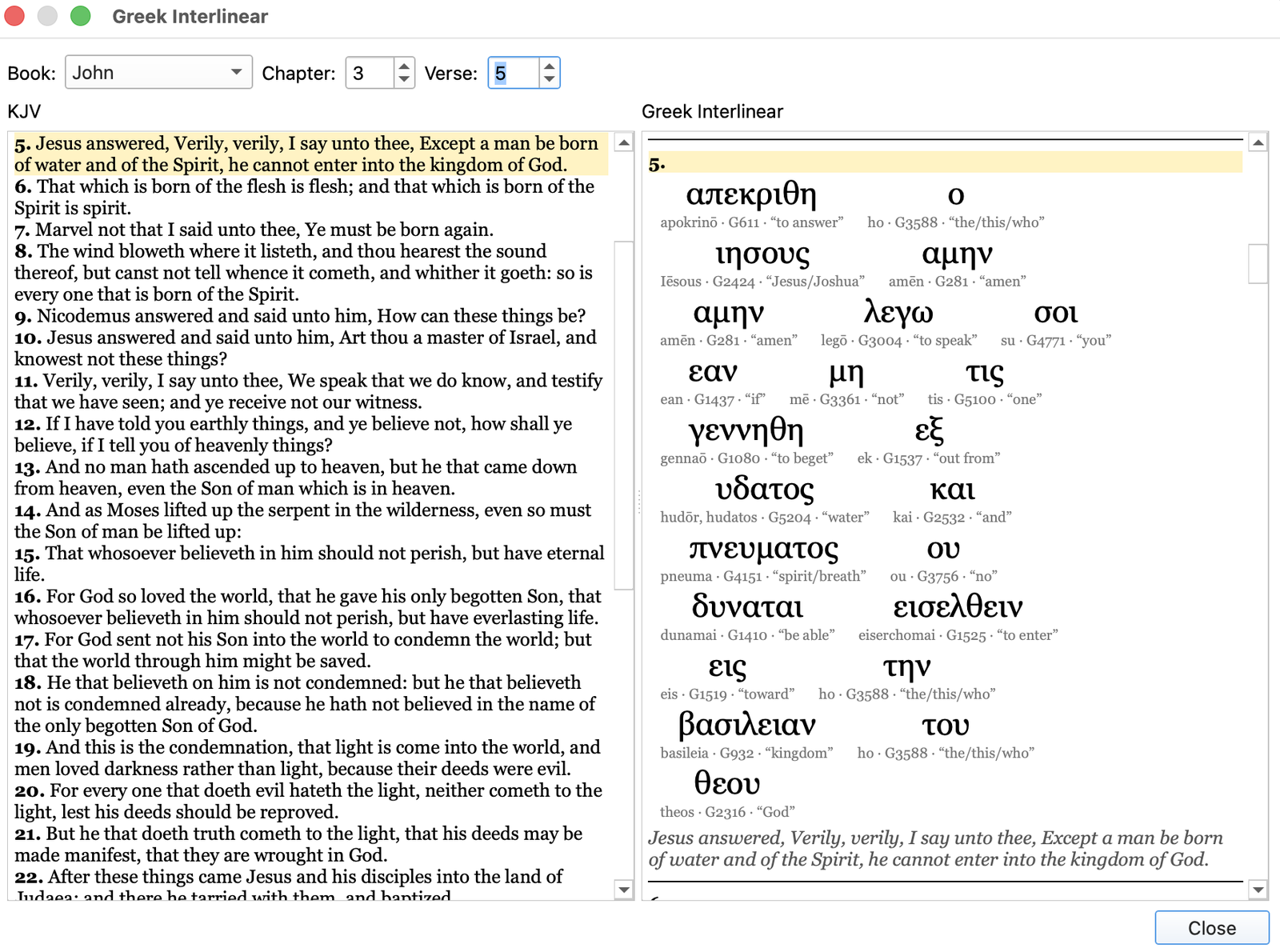
Read the Bible word by word in its original language: Hebrew for the Old Testament and Greek for the New. Each word appears with its transliteration, so you can sound it out, and its English meaning. Hebrew reads right to left, just as it's written.
Strong's numbers and definitions
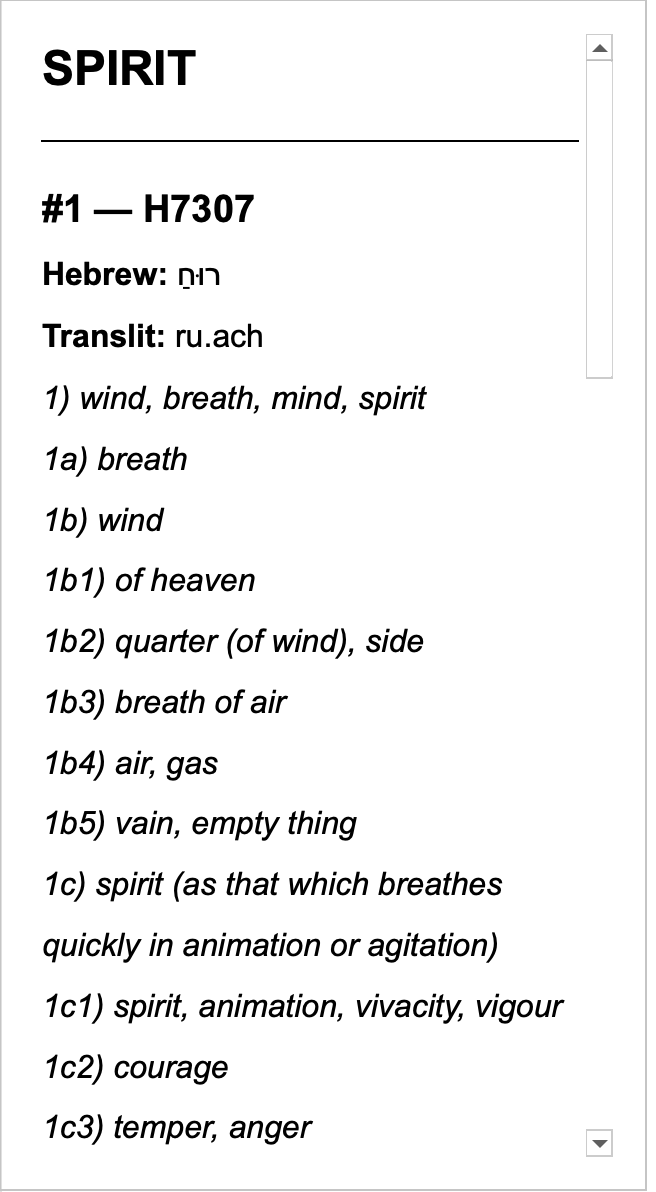
Look up an English word to find the Hebrew or Greek word behind it, its Strong's number, transliteration, pronunciation and definition. It's often where a familiar verse opens up, as when “firmament” turns out to mean an expanse.
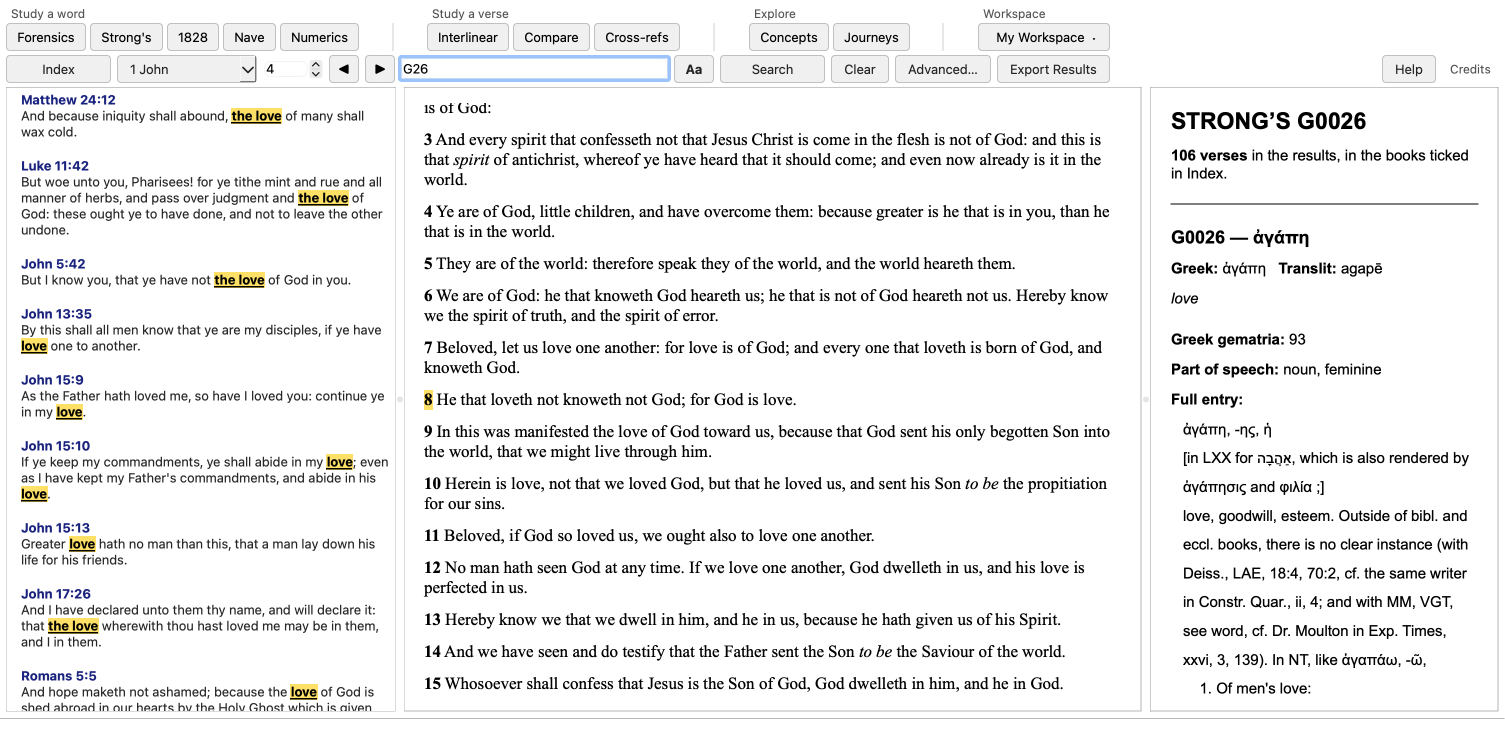
Type a Strong's number instead, such as G26 or H2617, and you get every verse where a KJV word carries it, with those words highlighted, and every English word the KJV uses to translate it.
Choose Strong’s, Forensics, Webster’s 1828, Nave’s or Numerics, then click word after word in the chapter: each one opens in the tool you chose.
Honest about every link
Most words are linked straight from the tagged King James text. Where the tagged text left a word untagged and the app matched it by meaning to a Hebrew or Greek word in the same verse, it says so, and points you to the Interlinear to check it. Nothing is presented as more certain than it is.
The translators' supplied words
Words the King James translators added to complete the sense in English are shown in italics, as in the printed KJV, so you can see at a glance which words have no Hebrew or Greek behind them.
Webster's 1828 dictionary
Noah Webster's American Dictionary of the English Language, 1828. English words shift in meaning over the centuries; this shows how a word was understood when many older Bibles and reference works were in everyday use.
Numerics
Hebrew and Greek letters have long doubled as numbers, so every word has a value. The LivingWordApp calculates these values, counts how often words occur, and gives you a workbench for following what you find.
Forensics: a word at a glance
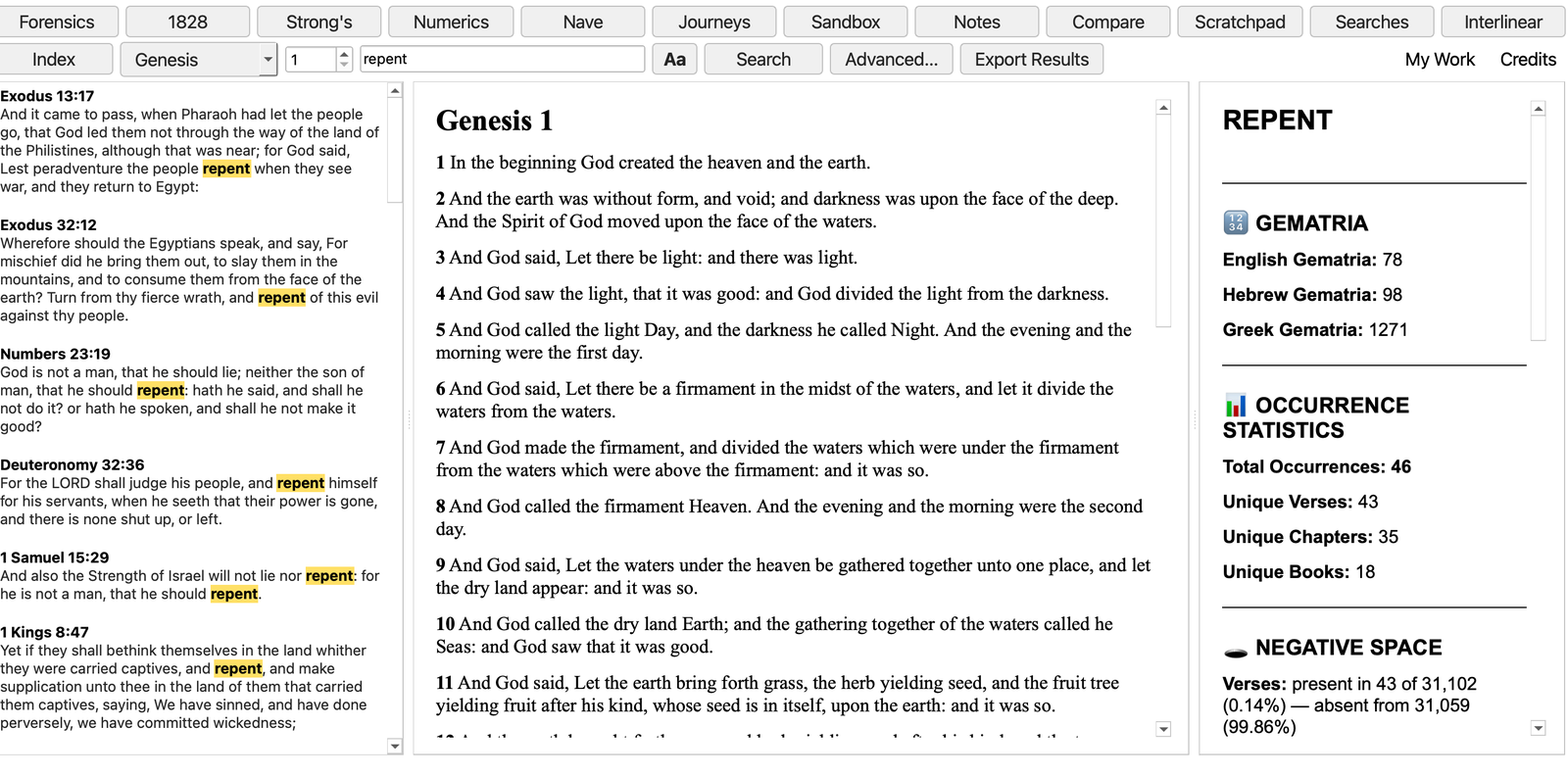
Type a word to see its gematria value in Hebrew, Greek and English, how many times it occurs in the King James Version, how many verses, chapters and books it appears in, and which books use it most. Select a book to list every occurrence in it.
The Sandbox
Start from a word or phrase, a verse, or a number. A verse card breaks the verse down word by word with a running total. From any card you can branch out:
- Check it: prime, triangular, Armstrong number, perfect square or cube, prime factorization, digital root.
- Combine it with another card or number: sum, product, or whether one divides the other.
- Keep going. Every result is a new card, so the path from your first number to your last stays visible.
Hebrew and Greek gematria are on by default, because they're long-standing historical practices. English gematria (A=1, B=2, and so on) is a modern convention, so it's there when you want it but off until you turn it on. Every card is labeled with the system it came from, and anything combined across systems is marked as mixed.
Trim a verse to just the words you want, several at once, and its total and running totals are worked out again from the words left. Or type Hebrew or Greek straight in, such as the inscription over the cross in Matthew 27:37, and see its value word by word.
Save a whole session and pick it up later, or export just the cards you choose as a plain text file to share.

Scratchpad
Found something interesting that has nothing to do with today's study? Send it to the Scratchpad. It's copied there with everything branching from it, and waits until you have time to come back to it.
Common meanings, 1 to 40
A reference list of the traditional meanings associated with numbers 1 through 40, such as seven with completeness and forty with testing. It's there as background, kept apart from the calculations.
Translations
Compare
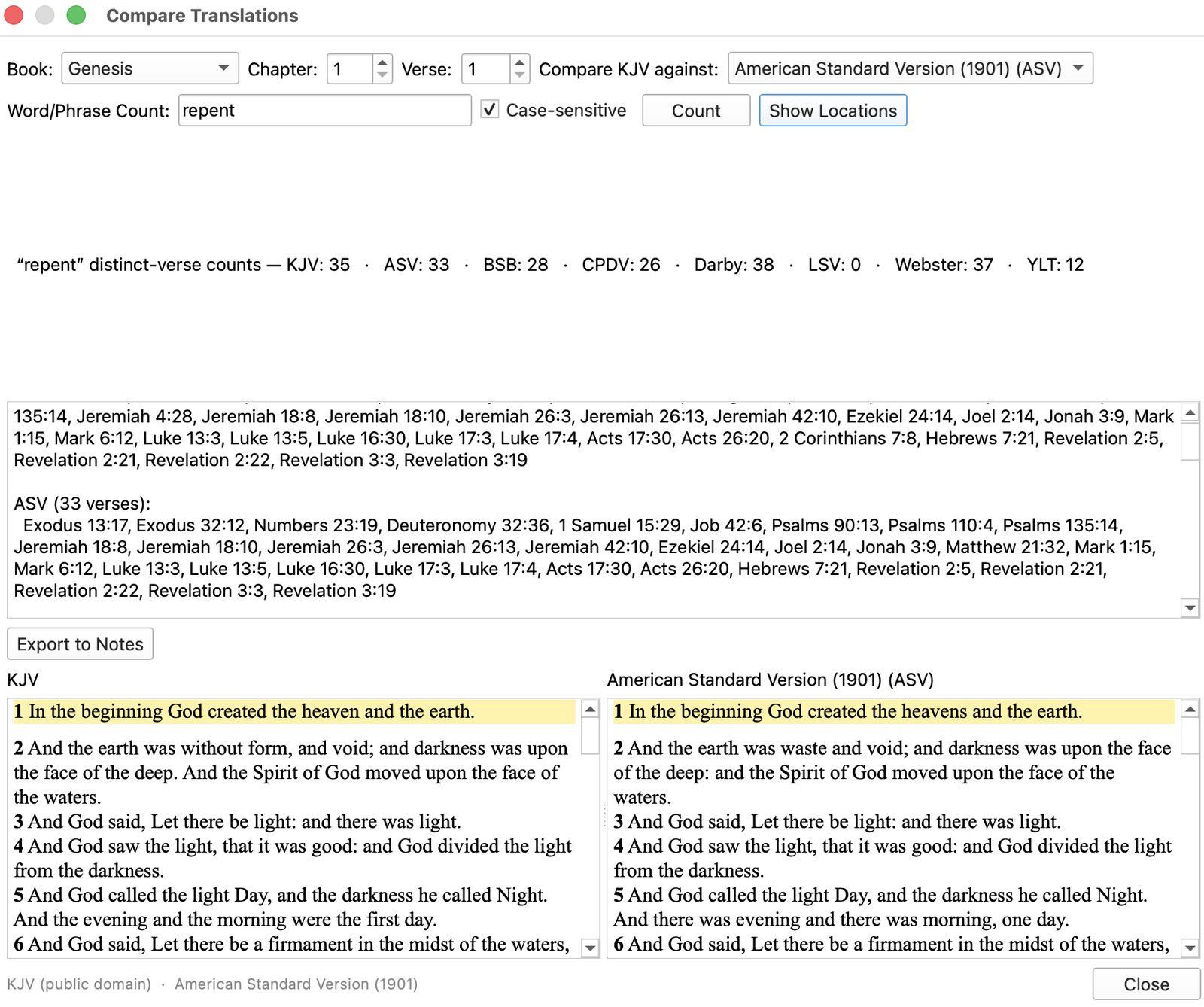
Read the King James Version beside any of seven other translations: the Berean Standard Bible, Literal Standard Version, American Standard Version, Darby, Webster's, Young's Literal Translation, and the Catholic Public Domain Version. Choose a verse and both sides line up with it highlighted. Where a translation leaves out a verse the King James includes, it's clearly marked rather than skipped.
Counts and locations
Count a word or phrase across all eight translations at once. Then list every verse where each translation uses it, with a summary of the verses where they disagree. Save the whole comparison to your notes.
Topics and connections
Cross-references
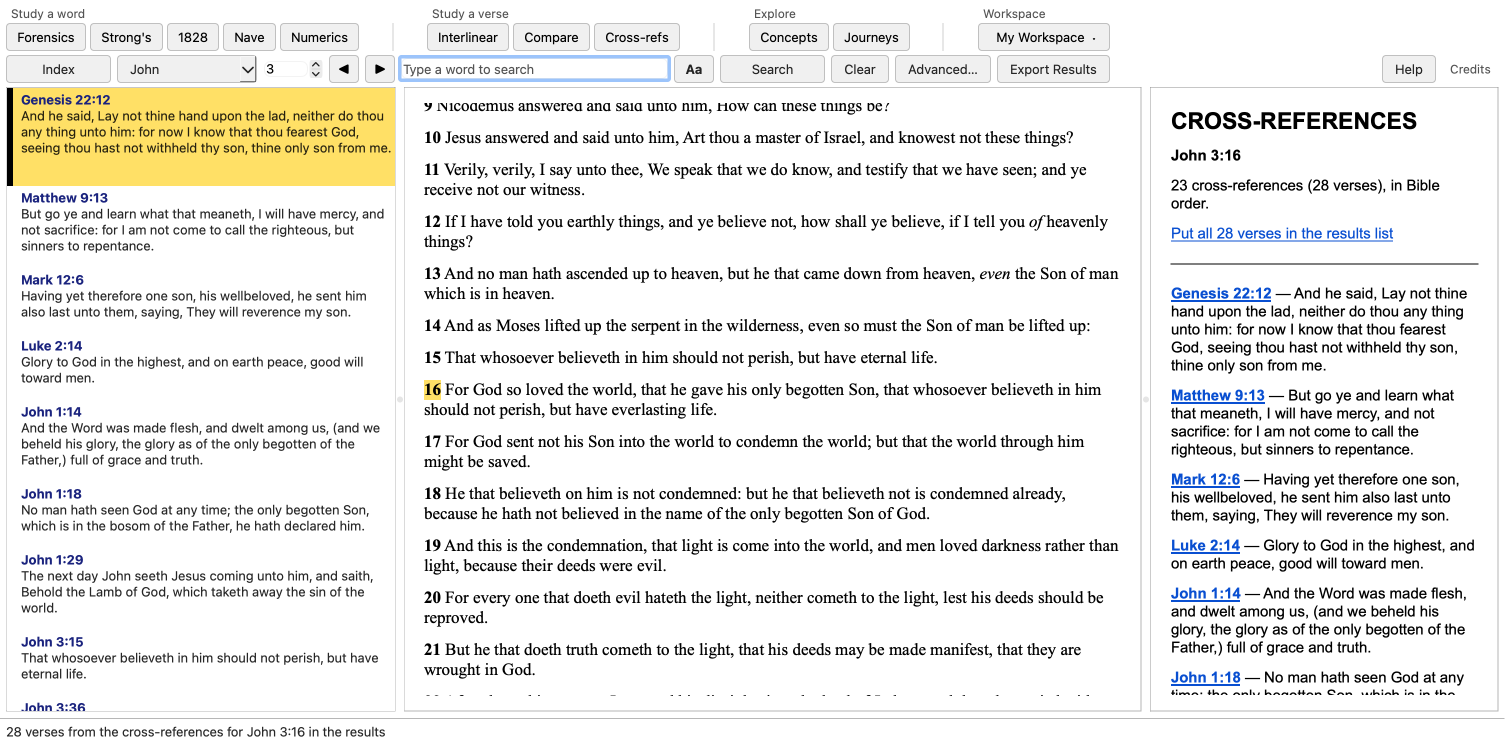
More than 340,000 links between related passages. Press Cross-refs on any verse to see its cross-references in Bible order, Genesis to Revelation, or turn the list round to see every verse that points to it. Put them all in the results list with one click.
Nave's Topical Bible
Study by subject rather than by word: find the verses on a topic even where the word itself never appears. Based on Nave's Topical Bible (1896), edited by TheLivingWordApp.
Concepts
Headings such as “The thief on the cross” gather the verses that belong together, in the order to read them, with sub-headings. Choose one and its verses open in the results list, ready to read and follow up. Concepts make no claims about what the verses mean: they’re a starting point for your own study.
Journeys
Follow the journeys of Scripture, from Abram's travels to Paul's missionary journeys, on maps that show every named stop along the way, with references for each place. Today’s cities, borders, seas and rivers can be shown too, so you can see where it all is now, and short journeys can be zoomed in close.

Your research
Search the whole Bible or just the books you choose, and export your results. Keep notes as you go. Notes, Sandbox sessions and the Scratchpad are saved on the drive automatically, and you can back them up to your computer or anywhere else you like.
All of this on one drive
$55.00, for two computers.
Buy the driveSources include the King James Version (1769 Cambridge edition), with word-by-word Strong’s numbers from eBible.org; Strong’s lexicon data from STEPBible by Tyndale House, Cambridge (CC BY 4.0); the Open Scriptures Hebrew Bible (CC BY 4.0) and Robinson’s Textus Receptus; seven other translations, six of them in the public domain and the Literal Standard Version under CC BY-SA 4.0; cross-references and place data from OpenBible.info (CC BY 4.0); journey routes from UBS Project MARBLE by Dr. Leen Ritmeyer (© United Bible Societies 2023, CC BY-SA 4.0); and Webster’s 1828 dictionary. The full list, with every license, is in the app’s Credits.